Friday, April 29, 2011

Recipe Week #4: My Italian Soul

While I greatly appreciate the Dutch mentality (e.g., bicycling, frugality, worship of sunlight, and excellent English skills), I think my soul might be Italian. I loved Rome more than any other trip we've made this year (and not just because Jeff proposed to me there), and I could eat pasta every day for eternity (damn the consequences). Something about Italian sunshine, Italian coffee bars, Italian hand gestures, and the beauty of certain Italian cities makes me extraordinarily happy. And then there's tiramisu.


My acculturation to all things Italian is significantly furthered, of course, by the fact that I am surrounded by Italians. I work for Italians, I work with Italians; we have an Italian neighbor, we have Italian friends. Sometimes I catch myself using hand gestures and I don't even know what they mean (which is dangerous, since most hand gestures - in Italian - mean something rather crass). If only more international organizations were based in Rome...

But for now, I will settle for learning to cook decent Italian food (or, as Jeff will be quick to point out, for encouraging Jeff to learn to cook decent Italian food). Luckily, a good friend of Jeff's from northern Italy once gave him a collection of her family recipes. Here's one we made recently - though fair warning, second helpings can induce instantaneous arterial hardening.

SALSA DI GORGONZOLA – BLUE CHEESE SAUCE

4 tablespoon Butter
½ cup Flour
2 cups Milk
½ cup crumbled blue cheese
Salt
Pepper
Nutmeg

Warm up the milk, but be careful not to boil it.

Melt the butter in sauce pan. As soon as it is completely melted, add the flour. Stir continuously with a whisk until you smell something like cookies.

Add the milk very slowly and continue to mix with a whisk until the sauce is smooth, with no lumps. Add salt, pepper, nutmeg and the cheese.

Bring to a (gentle) boil and cook for about 2-3 minutes.

Use with pasta and top (if you wish) with walnuts and parsley.

Warning: This makes a lot. You might consider cutting the recipe in half unless you have a family of 10.

Wednesday, April 27, 2011

Recipe Week #3: I say tabbouleh, you say tabbouli

When Jeff announced his great visa success, our lovely Lebanese friend presented him with the perfect "welcome home" gift: a Lebanese cookbook - and a promise to spend a day cooking with us.

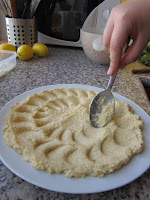
Plating hummus
We thus had our very own Lebanese cooking class a couple weekends ago, in which said friend taught us how to make hummus, tabbouleh, kefta, and fattoush just like her mother makes hummus, tabbouleh, kefta and fattoush. We also made falafel from scratch, but that was a new adventure for all of us.

All of these dishes are surprisingly straight forward (though they can be time consuming - try soaking and peeling a pound of fava beans, and you'll know what I mean). There's also a surprising amount of room for variation. Take tabbouleh, for instance: our friend feels very strongly about the fineness of the burghul (bulgar) -- it should be #1 burghul, not #2 -- and the amount (according to her, hardly any).

Other interesting notes on making tabbouleh: traditionally, you layer the ingredients carefully - the top layer being half onions and half tomatoes, neatly divided - and wait to mix in the dressing (lemon juice and olive oil) until you are ready to eat. Also, the spices are best mixed with the onions before the onions are added to the salad, as this helps ensure their even distribution in the final product.

Here's a general recipe for tabbouleh, copied/adapted from Lebanese Cuisine by Madelain Farab (who just happens to be a Portlander):

A little heavy on the tomatoes, imho
1/4 to 3/4 cup burghul (Farab recommends #2)
2 large bunches parsley, chopped very fine
About 1/4 as much fresh mint, also chopped fine
A few green onions, finely chopped (including the green part)
1 small onion, finely chopped and mixed with a bit of sumac, salt and pepper
2 large tomatoes, finely chopped
About 1/2 cup lemon juice and 1/2 cup olive oil (dress the salad to taste)

Rinse the burghul, drain it and squeeze it dry. Place it in a large mixing bowl and layer the parsley, mint, and green onions on top. Put the seasoned onions on one half of the salad and the tomatoes on the other half. When ready to serve, toss the salad with some lemon juice and olive oil (it should be fairly wet). Traditionally, the salad is eaten using grape leaves or lettuce (think pita bread and hummus).

As you can see, most of the work is in the chopping. Personally, I like more grain in the tabbouleh and more olive oil than lemon juice, but I can admit that here because I don't think our friend reads this blog.

Tuesday, April 26, 2011

Recipe Week #2: When in Holland...


Last winter, I had the bright idea that we should learn how to cook like the Dutch cook, just so we could make use of all that kale and rootworst and cabbage and endives we were seeing in the store. This lasted for about two meals, after which Jeff and I decided there was a reason why (1) the Dutch have a growing obesity problem and (2) most of the restaurants around town are Italian and Indonesian.

But during my short-lived enthusiasm for learning Dutch "cuisine", I did find a few helpful websites with collections of traditional recipes. Of the handful of recipes we tried, we actually really liked a couple of them - we just decided they were a little too heavy for everyday use.

This dish combines almost all the favorite Dutch food groups: smoked sausage, leeks, mashed potatoes, and cheese. It's also an example of the standard "stamppot" approach to Dutch cooking (that vegetables always taste better when mixed into mashed potatoes). I presume there is a significant ethnographic link between Dutch dishes like this and the casseroles of the American Midwest.

Who says cabbage can't be bad for you? Note that the "bacon" used by the Dutch is the thick slab kind that you cut into cubes (but regular American bacon should work fine). I would cut back significantly on the amount of jam the recipe calls for; otherwise, this dish can taste like candy.

You'll notice these recipes - like most of the recipes we encounter over here - measure amounts not by volume but by weight. At first this caused us some consternation, but then we bought a cheap kitchen scale at Ikea, and Jeff now swears by the greater precision that comes from weighing ingredients.

Monday, April 25, 2011

Recipe Week #1: Dutch Baby

My last morning in Portland, before my 10-hour flight back to Amsterdam, Mom made me our favorite childhood weekend treat - the appropriately named "Dutch Baby". 

Dutch Baby is one of those family traditions that seems so fixed and enduring, you are shocked as an adult to find out that no one else knows what the heck you're talking about. But I think Mom described Dutch Baby aptly when she compared it to "a giant popover" (at least, for those of you who know what a popover is).

So here's Mom's recipe (in her words), modified from Sunset Magazine (1977). This is best made in a cast-iron skillet; it rises like a souffle, but falls just as quickly. You cut it up like a pie and top it with butter, powdered sugar and lemon (in that order).

1/4 cup butter
3 eggs
3/4 cup flour
3/4 cup milk
Powdered sugar
Lemon slices

Have pan and ingredients at hand before you begin. Heat the oven to 425 degrees. Make sure everyone will be available when you take the pancake out of the oven in about 30 minutes.

Put the butter in the pan and set it into the oven to melt while you quickly mix the batter. 

Put the eggs into a blender or food processor and whirl for a minute or so to blend. Add milk and flour and beat another 30 seconds.

You can also make this with a rotary beater by beating the eggs until light and then gradually beating in the milk, then the flour.

Remove the pan from the oven and pour the batter into the hot melted butter. Return to oven and bake until puffy — 20 to 25 minutes.

Note: If the pancake doesn’t creep up the sides of the pan, the pan wasn’t hot enough when you added the batter. It’s somewhat of a juggling act to get the pan hot enough without browning the butter. Even if the pancake doesn’t rise, it will still be delicious.

And for the record, I have not seen Dutch Baby on any of the cafe menus here in the Hague.

Sunday, April 17, 2011

The Blue Envelope of Death


In honor of U.S. Tax Day:

As not-quite-a-staff member of my international organization, I fall into a sort of diplomatic limbo: I am allowed to live in the Netherlands, but otherwise I have no diplomatic privileges. You might be asking, who needs diplomatic privileges? Trust me, it helps.

Our first limbo-challenge was the realization that I had no status to sponsor Jeff's stay in the Netherlands. I felt impotent. Thus began our mad scramble to find any plausible grounds for Jeff to obtain a visa independently - and our full introduction to the logistical wrangling of expat life.

Everything as a non-diplomatic expat is a battle: opening a bank account (you have to register with the city first), registering with the city (the registration couldn't be finalized until Jeff submitted his residency application), submitting a residency application (which in Jeff's case required a bank account). Do you buy international health insurance or local health insurance? What's your back-up plan when they reject you for a seemingly minor pre-existing condition? 

And then there's the question of taxes. A staff member at my work would be exempt from Dutch taxes, and her salary would be grossed up to cover any U.S. taxes she could not otherwise get out of paying. Sweet! 

As for me: too bad, so sad. 

Sure, a delightful thing called the Foreign Earned Income Tax Exclusion allows me to avoid most federal and state taxes, but I still have to pay for Social Security and Medicare. Meanwhile, my colleagues assured me that I didn't have to worry about Dutch taxes unless the Dutch authorities (the Belastingdienst) came knocking on my door - which they do by sending you a letter in a bright bluish-purple envelope. No colorful envelope, no Dutch taxes.

This reassured me for about a month, until one day I came home to the blue envelope of death.

It could be worse. Actually, as it turns out, it could have been much worse. First, the Dutch tax authority prepared my return for me, in about 10 minutes. I cannot imagine typing the Dutch equivalent of a 1040 Form and accompanying instruction booklet into Google translate. Second, it turned out I make so little - even when entered as Euros (and have you seen the exchange rate lately??) - that I didn't owe any Dutch taxes after all. Sweet - or sad?

Still, we're stuck paying the city trash tax and the water pollution tax, which are not cheap, and I am sure other fees are lurking right around the corner. Thank god we have no children, cars, or pets (because there is a dog tax).